
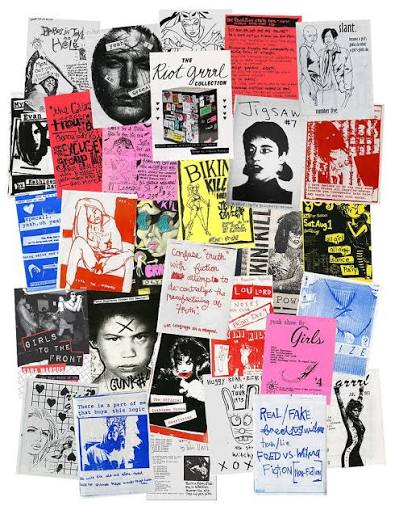
Any movement needs a vehicle for its message. Riot Grrrl had a few, the music itself was a way of communicating thoughts and feelings, but alongside the music itself was the abundant zine culture of Riot Grrrl. The word zine comes from fanzine which itself is derived from magazine. They are a kind of personalised newsletter and a forum for rants and artistic expression which originated in punk and anarchist circles as an alternative form of media and a platform for the ‘ordinary’ person. (Duncombe, 1998) Zines, which were an important part of the Punk scene in the late 1970s were a place “unhampered by corporate structure, cash and censorship,” (Burchill and Parsons, 1978) were co-opted by feminist movements such as Riot Grrrl although they were separate to punk zines, what differentiates zines is the motivation behind them. Grrrlzines first appeared in the early 1990s, around the same time as a grassroots movement of young puk feminists who would later become known as Riot Grrrls.
According to Rosenberg and Garofalo (1998) the zine network was identified as a form of communication which built trust among Riot Grrrls and was an accessible way to distribute information. These zines were crucial in setting out what Riot Grrrl was and what it stood for, they were a way in which the ideas discussed in the first Riot Grrrl meetings were distributed to grrrls around the United States. It was also in Issue 2 of the Riot Grrrl zine that Kathleen Hanna’s version of the Riot Grrrl manifesto was first published. Self-representation was at the centre of the Riot Grrrl movement and zines were a perfect and inexpensive way of doing so. Each zine was made up of art work, thoughts and feeling, rants and poetry and was a direct insight into the world of the girl making it. Many zines dealt with issues that the mainstream press tended to gloss over, including sexism, sexual assault and rape. Grrrlzines embodied the female experience and gave a voice to those marginalised by mainstream society. Each zine is a personal and political publication that can include topics ranging from activism and anarchism to body image third wave feminism and parenting. The way zines are written is completely unique because of the point of view of the authors and the demographic of the authors, the main demographic factor being their youth.
However this did mean that zine form and content were not always of the same quality that would make it through a mainstream publishers editorial process, however in some ways this means that the final product is totally authentic, unfiltered or polished by mainstream media, who wish to gloss over the issues that these grrrls wanted to bring attention to. Unlike blog posts of today the distribution of zines was somewhat controlled, which created an intimate bond between the writer and the reader. Zines tended to be created by individuals, not groups and were therefore more personal. True zines also avoided resembling corporate publications that other self-publications mimic. However, this is not to say that there wasn’t any form of organisation in Riot Grrrls booming zine culture.
The Riot Grrrl Press was a zine distributor which was started in 1992 by Erika Reinstein and May Summer (Also known as May Farnsworth) in Washington D.C. during the height of the Riot Grrrl movement’s popularity. Like many others May and Erika felt that they were creating alternative, girl-made, independent media for a reason. By creating a distribution network it would allow for the zines to speak for themselves. May and Erika saw The Riot Grrrl Press as an effective tool for combating the media’s appropriation of Riot Grrrl. The main idea behind the press was that if girl zines could be distributed on a larger scale, Riot Grrrls could express themselves to a larger audience without interference from the mainstream media.
The media blackout was an official policy of the movement in 1993. Riot Grrrls, approached by the media for comment on the movement, had agreed to only offer the address of The Riot Grrrl Press. This was to combat the misrepresentation of the Riot Grrrl movement that the mainstream press had so often been the source of. Although many grrrls agreed to this media blackout some did not which led to divisions within the movement. High profile Riot Grrls such as members of Bratmobile, Bikini Kill and Heaven’s To Betsy simply pointed reporters in the direction of The Riot Grrrl Press if asked about the movement.
The Riot Grrrl Press and the zines it distributed, encouraged readers to produce their own zines and become active consumers of the subculture. One of the more obvious main goals of these zines was self-discovery.
The distribution moved all over the United States with its founders, ending up operating from Olympia, Washington and Chicago in the mid 1990s. When the press was taken over by other people it moved again, the spring/summer catalogue in 1998 being published from Portland Oregon. The aim of the Riot Grrrl press was to publish zines written primarily by women or self-proclaimed Riot Grrrls. The method of publication worked by making copies of original flats from zines sent in by the authors which were compiled into catalogues and distributed around the country. The last known owners of The Riot Grrrl Press were the late 90s chapter of Riot Grrrl DC. Unfortunately, like many things, some critics of the movement argue that the zine movement was effectively over before it began, “the language style of Riot Grrrl was absorbed, repackaged and marketed back to us in the most superficial form of its origin.” (Bleyer, 2004)
Although there is some truth to this statement, it’s not entirely true. Young women around the world still continue to inhabit spaces both online and in print to express themselves. The ‘Gurl’ movement took place online, with the original ‘geekgirls,’ such as Rosie X, proclaiming that, ‘grrls need modems!’ and so the movement went online. Grrrls began creating e-zines, which belong to the zine movement by virtue of being self-produced. In 1976, Angela McRobbie stated that, “Girls negotiate a different leisure space and different personal spaces from those inhabited by boys. These in turn offer them different possibilities for ‘resistance’,” this still holds true today as women and girls will always create order to express themselves whether that be through printed zines or e-zines. Zine culture will always exist in relation to the female experience, The Riot Grrrl Press was just one of the first organised outlets for it.





Leave a Reply